
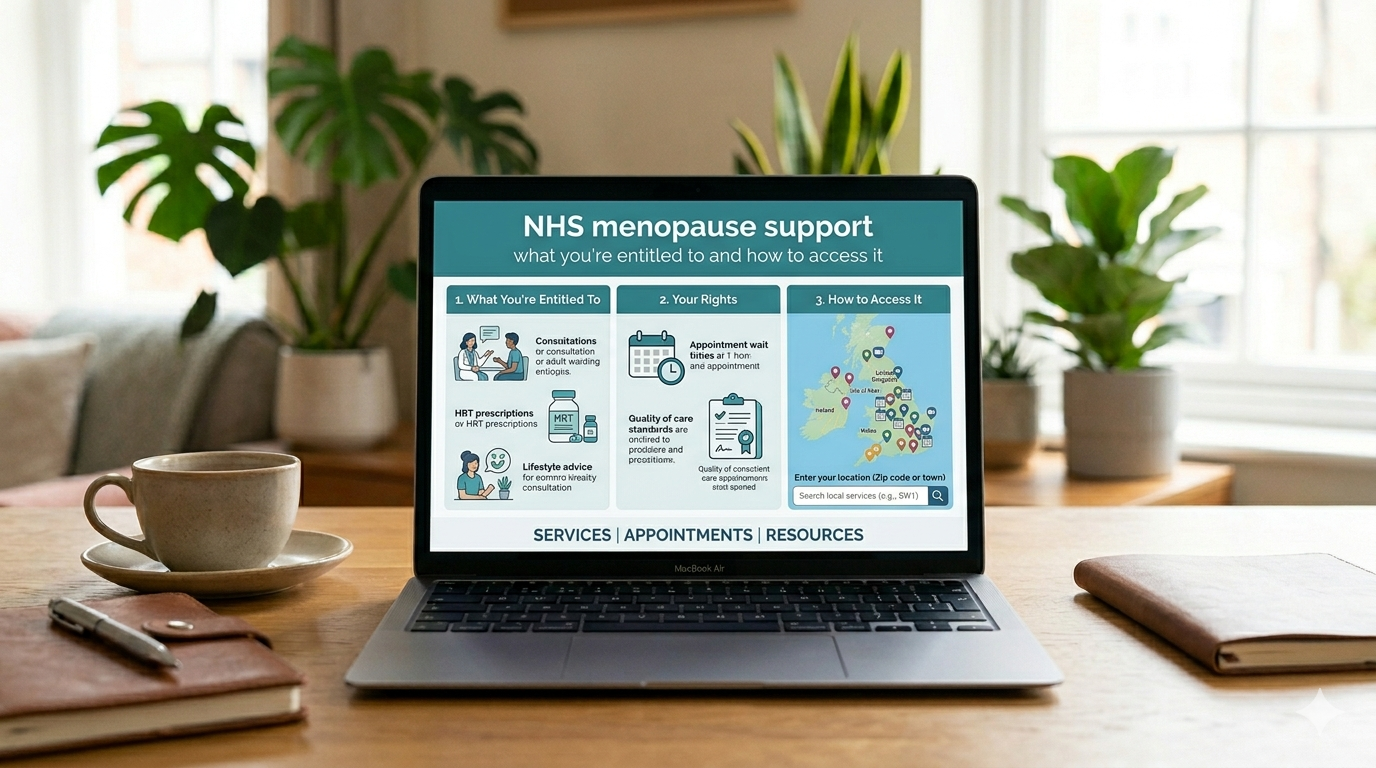
Every woman in the UK going through perimenopause or menopause is entitled to support from the NHS. Yet the reality of accessing that support varies enormously depending on where you live, which GP practice you are registered with, and how informed you are about your rights.
This guide sets out exactly what NHS menopause support you are entitled to in 2026, what has changed recently, how to access the care you need, and what to do if you are not getting it.
If you also want to compare local and private options, you can search menopause support services in The Menopause Directory.
What has changed in 2026: the NHS Health Check update
One of the most significant developments in NHS menopause care in recent years came into effect in England in 2026. Menopause has been added to the NHS Health Check, the free assessment offered to eligible adults aged 40 to 74 every five years.
This means that when eligible women attend an NHS Health Check, they should now be asked dedicated questions about menopause symptoms, their impact on daily life, and the support options available. The change is designed to identify women who need support and treatment sooner, before symptoms become severe, and to make menopause a routine part of preventive healthcare.
The Department of Health and Social Care announced that the update could benefit nearly five million women across England. It represents a formal recognition that menopause deserves proactive, routine attention within the NHS.
If you are aged 40 to 74 and have not had an NHS Health Check in the past five years, you can ask your GP surgery whether you are eligible. From 2026, that appointment should now include a conversation about menopause.
Your rights as an NHS patient going through menopause
Understanding your entitlements is one of the most powerful tools you have when navigating NHS menopause care. Many women do not realise how much they are entitled to ask for, which means they leave appointments without the support they need.
The right to a proper conversation about HRT
NICE publishes the main clinical guidance on menopause diagnosis and management, known as NG23, which NHS clinicians are expected to follow. The guidance says clinicians should discuss the benefits and risks of HRT with people experiencing menopause symptoms and should not routinely offer SSRIs, SNRIs or clonidine as first-line treatment for vasomotor symptoms alone.
If your GP has not discussed HRT with you as an option, you are entitled to raise it yourself and to have a detailed, evidence-based conversation about whether it is appropriate for your circumstances.
The right to a longer appointment
A standard GP appointment is rarely long enough to cover menopause symptoms properly. You can request a longer appointment, either a double appointment or an extended slot, specifically to discuss your symptoms in full. When booking, tell the receptionist that you need extra time to discuss menopause. Most practices can accommodate this with advance notice.
The right to see a different GP
If you feel your GP is not taking your symptoms seriously, is not offering the treatments NICE guidance recommends, or is simply not the right fit for a conversation about menopause, you can ask to see a different GP at your practice. Ask specifically to see a GP with an interest in women’s health or menopause.
The right to ask for a referral
If your symptoms are complex, if standard treatments have not worked, or if you have a condition that requires specialist input, you can ask for a referral to an NHS menopause specialist. You do not have to accept a refusal without explanation. If your GP declines, ask them to explain why a referral is not appropriate.
The right to a second opinion
If you are not satisfied with the care you are receiving, you can ask for a second opinion from another clinician. This applies both to diagnosis and to treatment decisions.
What your GP can provide on the NHS
Your GP is your primary point of contact for menopause support on the NHS and can provide a significant range of care without any referral needed.
Diagnosis
Perimenopause and menopause are usually clinical diagnoses. In women over 45 with typical symptoms, NICE guidance says diagnosis should usually be based on symptoms and clinical history, not routine hormone blood tests. Blood tests to check hormone levels are not routinely required and should not be used as a reason to delay treatment.
In women under 45, or where the diagnosis is unclear, blood tests may be appropriate. Your GP should explain their reasoning.
HRT prescription
Your GP can prescribe standard forms of HRT available on the NHS, including oestrogen patches, gels, sprays and tablets, as well as progesterone where needed. They can also prescribe vaginal oestrogen for genitourinary symptoms and, in some circumstances, may consider testosterone where this is clinically appropriate and locally supported.
If your GP feels unable to prescribe a particular formulation you have requested, ask them to explain why. You can then seek a second opinion or ask for a referral where appropriate.
Monitoring and follow-up
Once you are established on HRT or another treatment, your GP should provide review appointments to assess how the treatment is working, adjust doses where needed, and monitor your overall health. There is no fixed universal limit on how long you can continue HRT. The decision to continue should be made jointly between you and your clinician, based on your individual circumstances and preferences.
Referral to an NHS menopause specialist
For women with complex needs, your GP can refer you to an NHS menopause specialist based in a hospital outpatient department. This is often within gynaecology or endocrinology.
Referral may be particularly appropriate for women with premature ovarian insufficiency, surgical menopause, a history of breast cancer or other hormone-sensitive cancers, symptoms that have not responded to standard treatment, or significant cardiovascular or thrombotic risk factors.
How much does NHS menopause treatment cost?
Treatment from your GP is free at the point of use. Prescription charges apply to HRT medications in England unless you are exempt.
As of May 2026, the NHS Hormone Replacement Therapy Prescription Prepayment Certificate costs £19.80 for 12 months. It covers eligible HRT items and can be a significant saving for women who pay for prescriptions in England.
This is separate from the standard Prescription Prepayment Certificate. The 3-month standard PPC is £32.05, but the HRT PPC is the specific certificate designed for eligible HRT medicines.
Women who are exempt from prescription charges include those aged 60 or over, those with a valid medical exemption certificate, those on certain qualifying benefits, and those who already hold a general Prepayment Certificate covering all prescriptions.
In Wales, Scotland, and Northern Ireland, NHS prescriptions are free for patients, meaning HRT prescribed on the NHS is available without prescription charges.
What to do if you are not getting adequate NHS support
Many women find that accessing good NHS menopause care requires persistence and self-advocacy. If you are not getting the support you need, there are several steps you can take.
- Request a different GP within your practice, ideally one with an interest in women’s health or menopause.
- Ask for a longer appointment so you have enough time to discuss symptoms properly.
- Take a written symptom list and a copy of relevant NICE guidance to your appointment.
- Contact the practice manager if you feel the standard of care falls below what NICE guidance requires.
- Contact NHS England or your local Integrated Care Board if you believe you are being denied care you are entitled to.
- Consider a single private menopause consultation if you need a specialist treatment plan that your NHS GP can then consider implementing.
You can also use The Menopause Directory to find NHS referral pathways, private menopause clinics and community support services near you, so you understand the full range of options available.
NHS menopause support across the four nations
NHS menopause provision varies across England, Scotland, Wales, and Northern Ireland, although all four nations are currently investing in improvements to women’s health.
England
In England, the 2026 NHS Health Check changes represent a major recent development. NHS England has also announced that menopause and related women’s health issues will be among the priority areas for the new NHS Online service, which is expected to see first patients in 2027.
Scotland
In Scotland, the Women’s Health Plan: Phase Two 2026 to 2029 continues work to improve women’s health services, including menopause care. NHS Inform also provides national information through its women’s health resources.
Wales
In Wales, women’s health hubs are being developed across health board areas, with menopause, contraception and menstrual health among the priority areas. The Welsh Government has reported that hubs are intended to bring women’s health services closer to home.
Northern Ireland
In Northern Ireland, women’s health policy and service development continues to evolve. Availability of dedicated menopause services may vary, so it is worth asking your GP about local referral pathways and checking current local health trust information.
Find NHS and private menopause support near you
The Menopause Directory lists NHS referral pathways, private menopause clinics, online services and community-based support across the UK. Whether you are looking for information on accessing NHS care in your area, or exploring private and community-based options to complement what the NHS offers, the directory makes it easier to find the right support for your needs.
You may also find these guides useful:
- How to find a menopause specialist near you
- Private menopause consultations in the UK
- Online menopause clinics in the UK
- Menopause clinics in the UK
Frequently asked questions
What menopause support am I entitled to from the NHS?
You are entitled to a proper conversation about your symptoms, a discussion of treatment options including HRT where appropriate, a longer appointment if needed, a referral to a specialist if your symptoms are complex, and the option to ask for a second opinion if you are not satisfied with your care.
Can my GP refuse to prescribe HRT?
Your GP can advise against HRT in specific clinical circumstances, but they should not routinely refuse it to women with menopause symptoms without a detailed discussion of benefits and risks. If you feel HRT has been refused without good reason, you can ask for an explanation, request a second opinion, or ask for a referral.
Do I need a blood test to get menopause support from my GP?
Not routinely. In women over 45 with typical menopause symptoms, NICE guidance says diagnosis should usually be based on symptoms and clinical history, not routine blood tests. Blood tests may be appropriate in women under 45 or where the diagnosis is uncertain.
What has changed with NHS menopause support in 2026?
In England, menopause has been added to the NHS Health Check, the free assessment offered to eligible adults aged 40 to 74 every five years. Women attending this check should now be asked dedicated questions about menopause symptoms and support options.
How do I get referred to an NHS menopause specialist?
Ask your GP for a referral. This is most appropriate if your symptoms are complex or severe, if standard treatments have not worked, or if you have a relevant medical history such as premature ovarian insufficiency or a history of hormone-sensitive cancer. If your GP declines, ask them to explain why and consider requesting a second opinion.
How much does HRT cost on the NHS?
In England, prescription charges apply unless you are exempt. As of May 2026, the HRT Prescription Prepayment Certificate costs £19.80 for 12 months and covers eligible HRT items. In Wales, Scotland, and Northern Ireland, NHS prescriptions are free.
What should I do if my GP dismisses my menopause symptoms?
Ask to see a different GP at your practice, ideally one with an interest in women’s health. If you feel the care falls below what NICE guidance requires, contact your practice manager. You can also contact NHS England or your local Integrated Care Board. A single private consultation with a menopause specialist may also provide a treatment plan your NHS GP can consider implementing.
Is menopause support the same across England, Scotland, Wales, and Northern Ireland?
The broad principles of menopause care are similar across the UK, but access to specialist services and prescription costs vary. Prescriptions, including HRT, are free in Wales, Scotland, and Northern Ireland. England has introduced menopause questions into the NHS Health Check from 2026.

Author: The Menopause Directory
About this guide
This guide is published by The Menopause Directory editorial team to help UK readers understand menopause symptoms, support options and services. It is for general information only and should not replace advice from a GP, pharmacist or qualified menopause specialist.
Last reviewed by The Menopause Directory editorial team.