
Browse All Listings
Menopause Community Support in the UK
Menopause affects every part of a woman’s life — her body, her mind, her relationships, her work, and her sense of self. And yet for many women, the experience of going through it can feel profoundly isolating. Symptoms are often invisible. Conversations are frequently shut down. And clinical appointments rarely leave enough time to talk about how you’re actually feeling.
That’s where community support changes everything.
This directory lists verified menopause community support services across the UK — including local in-person groups, online forums and communities, Menopause Cafés, peer networks, workplace support groups, and specialist communities for women navigating early menopause, surgical menopause, and menopause alongside other health conditions. Whether you’re looking for a friendly face in your local area or a safe space to connect online, you’ll find your community here.
Why Community Support Matters During Menopause
The evidence is clear: peer support and community connection make a meaningful difference to how women experience menopause. Research published in peer-reviewed journals consistently shows that shared experiences reduce stress and build resilience. Women who connect with others going through the same transition report lower levels of isolation, improved confidence in navigating healthcare, and a greater sense of control over their symptoms and their lives.
Over 33 million women in the UK will go through menopause. Yet research shows that menopause is still largely unspoken about in wider society, and that many women feel dismissed, unheard, or simply alone with their experience. A 2025 systematic review of UK women’s menopausal experiences found that talking to others who understood what they were going through was one of the most consistently valued sources of support — often more immediately accessible and emotionally meaningful than a GP appointment.
Community support does not replace medical care or professional coaching. But it fills a vital gap: the human connection, shared understanding, and practical knowledge-sharing that help women realise they are not alone, not imagining it, and not without options.
As one community participant put it: “These groups really have accounted for 90% of me maintaining any kind of sanity at this time. It is invaluable to meet with people who know exactly what you’re going through.”
Types of Menopause Community Support Available in the UK
Menopause community support in the UK comes in many forms. The right fit depends on your personality, circumstances, and what you’re looking for.
Local in-person support groups meet regularly in community venues, libraries, health centres, and wellbeing hubs. They are typically facilitated by a trained leader or peer volunteer and provide a safe, confidential space to share experiences, ask questions, and find connection. Many are free to attend.
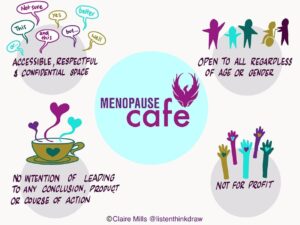
Menopause Cafés are informal, drop-in events where people gather — often over tea and cake — to talk openly about menopause without agenda or pressure. Run by volunteers across the UK and inspired by the Death Café model, Menopause Cafés are open to everyone: women at any stage, their partners, friends, family members, and colleagues. There is no booking required at most events, no medical agenda, and no expectation. They are joyful, honest, and increasingly popular.
Online forums and communities allow women to connect, ask questions, and share experiences at any time of day, from anywhere. Long-established communities such as Menopause Matters — one of the UK’s most active menopause forums — have members posting every day across a huge range of topics. Private Facebook groups, WhatsApp communities, and dedicated apps offer additional spaces for more personal conversation.
Workplace menopause support networks are growing rapidly. The UK Government and CIPD both recognise the value of employer-led peer networks — and with the Employment Rights Act 2025 encouraging businesses to publish Menopause Action Plans, more organisations are creating dedicated groups, menopause champions, and peer support structures for staff. Research suggests that only around a quarter of women are aware of an existing menopause policy at their workplace, and only 46% of those with employer support have access to a dedicated network — meaning significant growth is still ahead.
Specialist communities serve women with specific experiences of menopause that the mainstream conversation often overlooks: premature ovarian insufficiency (POI) and early menopause, surgical menopause, menopause after cancer treatment, menopause alongside neurodivergent conditions such as ADHD and autism, and menopause within LGBTQ+ communities. These spaces provide understanding, validation, and peer knowledge that is hard to find elsewhere.
Charity-led support services such as The Menopause Charity, Menopause Support (founded by Diane Danzebrink), and the Daisy Network (for POI) provide free information, resources, peer connections, and advocacy — all independently run and centred on the needs of women navigating menopause.
What to Expect from Menopause Community Support
The best menopause community support spaces are non-judgmental, inclusive, and confidential. They welcome women at all stages — from the earliest signs of perimenopause through to post-menopause — and most explicitly welcome women supporting others, including partners, carers, friends, and family members who want to better understand what the people they love are going through.
Community support is not therapy, and it is not medical advice. Good groups make this clear: they provide a space to share and be heard, not to diagnose or prescribe. Many groups signpost members toward coaches, clinicians, and charities when more specialist support is needed. A well-run group can in fact accelerate the journey toward appropriate clinical care — by helping women learn what questions to ask, understand what treatments exist, and feel confident enough to advocate for themselves at a GP appointment.
What community support does particularly well is address the emotional and relational dimensions of menopause that clinical care often cannot reach: the grief of losing a former self, the strain on relationships, the shame and secrecy that still surrounds this universal experience, and the simple, profound relief of being told by someone who has been there: “I understand. I felt that too.”
Finding Menopause Community Support in United Kingdom
Browse verified menopause community support services in United Kingdom below. Each listing includes information on the type of support offered, who it is for, whether it is free, and how to get in touch or attend.
FREQUENTLY ASKED QUESTIONS ABOUT MENOPAUSE COMMUNITY SUPPORT IN THE UK
FAQ 1: What is menopause community support and who is it for?
Menopause community support refers to any peer-led, group, or community-based resource that helps women navigate perimenopause, menopause, and post-menopause alongside other people who understand the experience. It includes local support groups, online forums, Menopause Cafés, workplace networks, charity helplines, and specialist communities for particular groups such as those with premature ovarian insufficiency or surgical menopause. Community support is for any woman at any stage of the menopause journey — whether she is just beginning to notice perimenopausal changes or is well into post-menopause — and in most cases also welcomes partners, family members, and friends who want to better understand and support the women in their lives.
FAQ 2: Is menopause community support free?
Most menopause community support in the UK is free or very low cost. Local in-person support groups, Menopause Cafés, online forums, charity helplines, and many online communities carry no charge. Some online communities and apps offer free basic access with optional paid membership for additional resources. Workplace support networks provided by employers are free to employees. Specialist charity memberships — such as the Daisy Network for women with premature ovarian insufficiency — may carry a small annual fee, the proceeds of which go directly toward supporting members. Paid group coaching programmes and facilitated wellbeing retreats sit at a different point on the spectrum but offer more structured support for those who want it.
FAQ 3: What is a Menopause Café and how do I find one near me?
A Menopause Café is an informal, drop-in community event where people meet to talk openly and honestly about menopause over a cup of tea or coffee. Run by volunteers across the UK, Menopause Cafés have no agenda, no medical content, and no pressure — just open conversation in a welcoming space. They are open to everyone regardless of gender, age, or whether they are personally going through menopause. Menopause Cafés take place in community halls, cafés, libraries, and workplaces. You can find your nearest event through the Menopause Café website (menopausecafe.net), which lists upcoming public and workplace events across the UK. Many events require no booking — you can simply turn up. The listings in this directory also include local Menopause Cafés in United Kingdom.
FAQ 4: How is community support different from seeing a menopause coach or clinic?
Community support, coaching, and clinical care serve different but complementary needs. A menopause clinic provides medical diagnosis, prescriptions, and clinical management — things that require a qualified doctor or nurse. A menopause coach provides personalised, structured support for lifestyle, emotional wellbeing, and practical skills — a paid professional relationship. Community support provides something different: peer connection, shared experience, and a sense of belonging — usually free, informal, and led by or alongside people who are going through the same thing. Many women find that community support builds their confidence and knowledge to a point where they feel better equipped to get the most out of their clinical appointments or coaching sessions. The three forms of support work best together rather than in competition.
FAQ 5: Are menopause support groups confidential?
Most well-run menopause support groups operate under clear confidentiality agreements — what is shared in the group stays in the group. This is an expectation that is set by the facilitator at the outset and reinforced throughout. Online forums and communities often offer the option of anonymity, allowing members to post under a username. Some women find online communities easier to open up in precisely because of this. If confidentiality is important to you, it is always worth asking the group organiser how it is maintained before attending for the first time. Workplace support groups may need to be approached with more care depending on your employer’s culture — ask the group organiser how privacy is handled if you have concerns.
FAQ 6: What kinds of things do menopause support groups talk about?
Menopause support groups cover a wide and honest range of topics — far broader than many women expect. Common themes include unusual or embarrassing symptoms that feel impossible to discuss elsewhere, frustrations with GPs and the NHS pathway, experiences of HRT (what’s working, what isn’t, how to access it), brain fog and its impact on confidence and work, anxiety and low mood, sleep disruption, changes in relationships and libido, weight and body image, identity and what this life stage means for sense of self, and practical tips that members have found helpful. Many groups also discuss the latest menopause news and research, helping members stay informed in a rapidly evolving landscape. There is typically no topic that is off-limits in a well-facilitated group.
FAQ 7: Is there menopause community support specifically for younger women or those with early menopause?
Yes. Premature ovarian insufficiency (POI) — menopause before the age of 40 — is a distinct experience that requires its own support spaces. The Daisy Network is the UK’s leading charity dedicated to supporting women with POI, offering peer connection, specialist information, and access to a community of women who understand the unique emotional and medical challenges of early menopause. Surgical menopause — caused by removal of the ovaries — is another experience that benefits from specialist peer support, as it can arrive suddenly and at any age. Some online forums and local groups specifically welcome younger women navigating early or surgical menopause, where the experience of going through menopause while peers are raising young children or at very different life stages can feel particularly lonely.
FAQ 8: Is there menopause community support for women with ADHD, autism, or other neurodivergent conditions?
Yes, and this is a growing and important area. The intersection of menopause with ADHD and autism is increasingly recognised — hormonal changes during perimenopause can significantly amplify neurodivergent traits, and many women receive an ADHD or autism diagnosis for the first time in midlife because the hormonal changes strip away the coping strategies they had previously relied on. Some community groups specifically welcome and centre the neurodivergent menopause experience. The Menopause and Mind project, for example, explicitly acknowledges the link between menopause symptoms and autism and ADHD, and structures its peer support around these intersections. Online forums are often a particularly accessible format for neurodivergent women who may find in-person group settings overwhelming.
FAQ 9: Can partners, family members, or friends attend menopause support groups?
Many menopause community support events are explicitly open to partners, family, and friends — and actively encourage their attendance. Menopause Cafés, for example, welcome anyone interested in menopause regardless of whether they are personally going through it. Including the people who live and work alongside menopausal women in community conversations helps break down the isolation that so many women feel and builds understanding in households, workplaces, and communities more broadly. Some support groups, however, are women-only or structured specifically for people experiencing menopause directly — it is always worth checking the group’s format before attending with a partner or family member.
FAQ 10: What is a menopause champion and how are they different from a support group?
A menopause champion is typically a volunteer within a workplace — often someone with personal experience of menopause — who acts as a point of contact and advocate for colleagues going through the transition. Champions are not counsellors or coaches: they signpost colleagues to appropriate resources, help create a culture where menopause is spoken about openly, and support the implementation of workplace adjustments and policies. A menopause support group is a regular meeting space for peer connection and conversation. Many organisations have both: champions who hold the culture change brief and signpost individuals, and peer groups where members meet regularly to share experiences. With the Employment Rights Act 2025 encouraging larger UK employers to publish Menopause Action Plans by 2027, both roles are growing in visibility and importance.
FAQ 11: Are there online menopause support communities I can join from home?
Yes — and online communities are one of the most widely used forms of menopause support in the UK. Menopause Matters (menopausematters.co.uk) has one of the longest-established and most active UK menopause forums, with members posting daily on every aspect of the experience. Facebook hosts numerous private groups with thousands of members. Dedicated menopause apps offer built-in community features alongside symptom tracking and expert content. Many coaching practices and clinics also run private online communities for their clients as part of their programmes. Online support is particularly valuable for women who live in areas where in-person groups are scarce, who have mobility limitations, or who simply feel more able to open up in writing and with the option of anonymity.
FAQ 12: How do I know if a menopause support group is safe and well-run?
A good menopause support group will have a clear facilitator or organiser who sets the tone and maintains boundaries. It will have an explicit confidentiality agreement. It will make clear what it is — peer support — and what it is not — medical advice or therapy. It will be welcoming, inclusive, and non-judgmental, and will signpost members toward coaches, clinicians, or charities when additional support is needed. Red flags to watch for include groups that promote specific commercial products, groups where misinformation about HRT or other treatments goes unchallenged, and groups that discourage members from seeking medical help. The best groups empower women to make informed decisions, not to follow a particular ideology about how menopause should be managed. The listings in this directory have been verified for quality and accuracy.
FAQ 13: Can menopause community support help with the emotional and mental health impact of menopause?
Yes — and for many women, this is where it has the greatest impact. Menopause has significant mental health dimensions: heightened anxiety, low mood, brain fog, identity shifts, grief, and in some cases depression are all common. A 2024 UK survey of menopause specialists found that 43% estimated that over half of their patients with mood symptoms would benefit from psychological support — yet 80% did not have a designated mental health practitioner attached to their clinic. Community support helps fill this gap by providing a space to voice and validate emotional experiences that are often invisible in clinical settings. Hearing that others feel the same reduces shame, normalises the experience, and builds resilience. It is not a substitute for professional mental health support when that is needed, but it can be a meaningful and accessible complement to it.
FAQ 14: Is there menopause support available for LGBTQ+ women and trans or non-binary people?
Yes, though dedicated spaces can take more effort to find. Menopause is not exclusively a women’s experience: trans and non-binary people may also experience menopause and deserve access to support that is culturally sensitive and inclusive. Some online communities and progressive support groups explicitly welcome LGBTQ+ members and are thoughtful about language and lived experience. The landscape is evolving: broader menopause community organisations are increasingly recognising the importance of inclusivity, and specialist LGBTQ+ health organisations offer signposting to menopause support. When searching for a group, it is always worth checking how inclusive its language and approach are — the listings in this directory note where groups are explicitly inclusive of all gender identities.
FAQ 15: How do I start a menopause support group in my area?
Starting a menopause support group in your community is more achievable than you might think, and the need is almost certainly there. The Menopause Café model offers a ready-made framework — you simply need a venue, a commitment to confidentiality, and a willingness to hold space for honest conversation. The Menopause Café charity provides free guidance and a toolkit for setting up your own event. For more structured peer support groups, organisations such as Menopause Support and The Menopause Charity offer resources for community facilitators. A local venue — library, community centre, café, or GP surgery — will often support a group like this at low or no cost. Many of the most valued support groups in the UK started with one person who simply decided that the conversation needed to happen in their town.